
Not a Crook: The Troubling Journey to the Public Redemption of Richard Nixon (TT26)
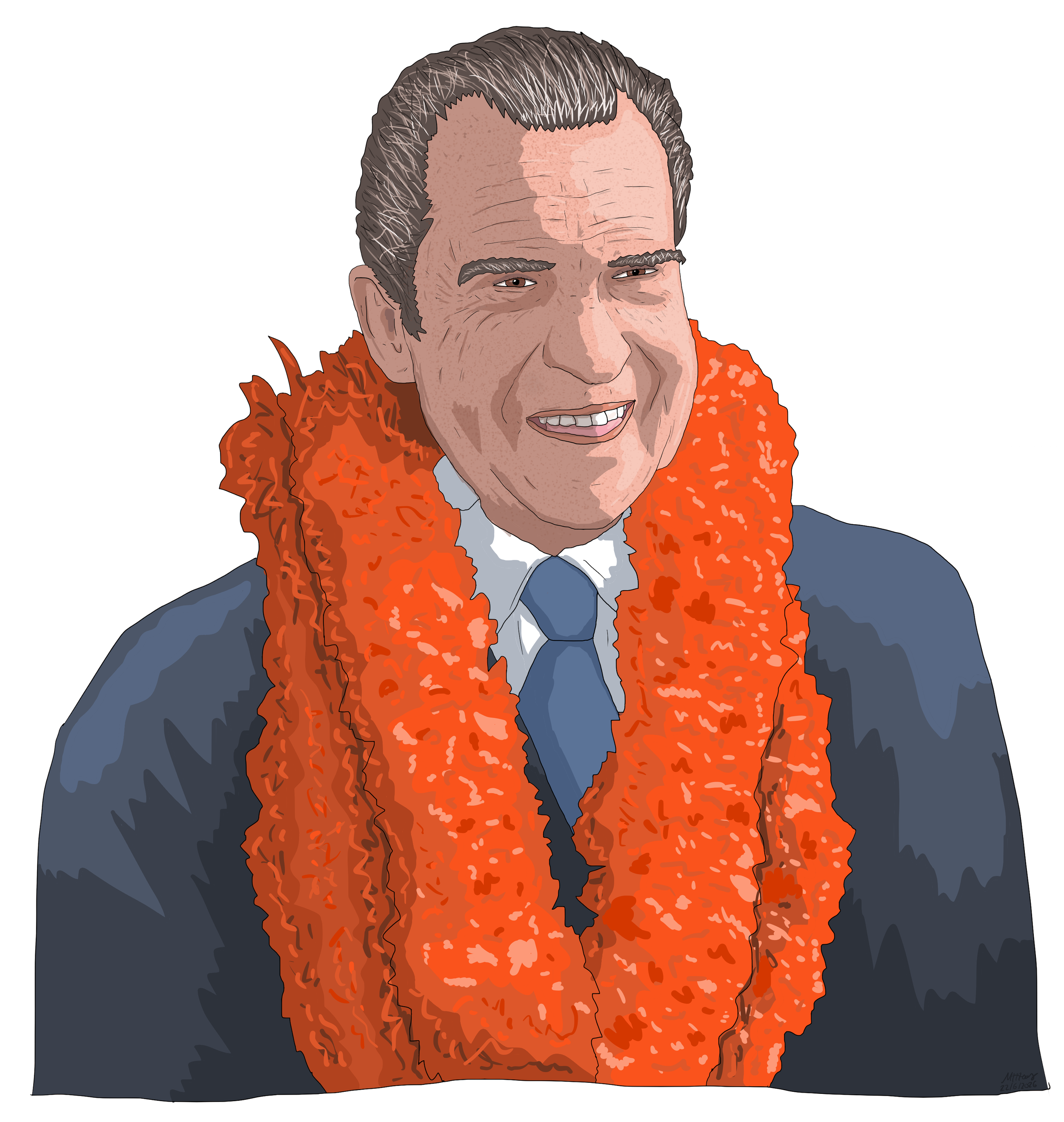
Nixon is a fascinating historical character. He is Shakespearean in his intricacies, his flaws and his tortured sense of self. That does not make him a good person, nor one worthy of redemption.
In 1976, if you had asked an average American about Richard Nixon, you would be hard pressed to find a favourable response. Saved from being the first president ever removed from office through the impeachment process by a mission from the Republican Senate Caucus (led by Barry Goldwater) which convinced him to resign, Nixon’s name was synonymous with disgrace. That Gerald Ford came so close to becoming president, even after pardoning the man, is testament not only to the Republican Party’s organisational strength, the fact that Ford was one of the more impressive individuals to sit in the Oval Office, and the Herculean efforts of Ford and his team: it also demonstrates the campaigning weakness of Jimmy Carter who, for all his grasp of the changed primary process, appeared to be deserted by his campaigning nous when the 1976 election began in earnest. However, Carter’s southern credentials carried him narrowly over the line, as did Gerald Ford’s 1975 ‘drop dead’ message to New York City as he refused to bail the city out: the message delivered all five boroughs, the state, and the election to Carter, the former peanut farmer.
Yet much like his equally reprehensible counterpart Henry Kissinger, Nixon’s reputation has experienced rehabilitation over the decades since his leaving office. Rebranding himself as a dignified elder statesman, not even the disastrous Frost interview, where he announced that, “If the president does it, then it’s not illegal,” could stunt the resurrection of Nixon’s credibility. By the time of his death in 1994, he could count incumbent Democratic president Bill Clinton as a friend, with the Arkansas native turning to the Californian Nixon when in need of counsel. Appropriately, Clinton would later be impeached by the House for lying to Congress regarding his knowledge of the Lewinsky Affair. In response to the more brutal strain of politics ushered in by the 1990s, confirmed by the rancour of the 2000 election, the chaos of Iraq and 2008, and the rise of Trumpism, Nixon is increasingly seen as a historical figure of repute; a touchstone for when politics was kinder, gentler, and more decent. The Nixon Foundation has played its part in spreading these myths, churning out content depicting Nixon as simultaneously a reasonable moderate and a respectable conservative.
This myth cannot be allowed to stand. Notwithstanding his appalling personal behaviour – treating his wife, Pat Nixon, badly even by the already-low standards of the 1950s, completely sacrificing her wellbeing and happiness for his own, ultimately failed, career - Nixon is the sort of reprobate who deserves to be discussed in the same breath as Nero, Herod, King John, Ivan the Terrible, Aurangzeb, Papa Doc Duvalier or Ceausescu. Few administrations, in their policies or in their deeds, have done more damage to the globe and the United States since the Buchanan administration, whose complicity in the verdict of the Dred Scott Supreme Court decision helped ferment the secessionist intentions of the slave power in the south.
Much has been made of Nixon’s humble origins making him the voice of the ‘silent majority’ of Americans denied influence in their country. His origins were certainly humble – Nixon had to attend the local Whittier College due to a lack of funds to attend an Ivy League college, and he lost two siblings in childhood, living in spartan conditions with strict parents. Still, he is not unique in this respect. Lyndon Johnson experienced the poverty of the Texas Hill Country; Harry Truman returned from World War One only for his haberdashery business to go under in the 1921 recession, leaving him paying off debts for twelve years; Gerald Ford and Bill Clinton both had abusive fathers their mothers left; and Jimmy Carter had to abandon a distinguished career in the Navy for the relative poverty of his family’s failing farm after his father’s death. That is not to say Nixon never knew poverty - he did - nor to say that his upbringing was not severely challenging. It was, but he was not some rarity in the American presidency, the only humble-boy-come-good to arise out of the heaving body of the populace. The rest of the occupants of the Presidency with a similar background stood for something; Nixon had nothing more than rhetoric and the media-friendly rendition of his background he produced during his campaigns for public office. In this retelling, Nixon’s parents did not abuse him, and it was solely through his individual agency and spirit – not the support of rural California’s media magnates – that saw him return from relatively undistinguished service in World War Two to be elected to the House of Representatives.
This is far from the truth. Take Nixon’s early career. A more palatable McCarthy, his correct labelling of Alger Hiss as a Communist was baselessly expanded to smear dozens of federal civil servants, lending ammunition to the Lavender Scare’s targeting of homosexuals within the US government on the basis of their weakness to Communist blackmail. His service as vice president to Eisenhower was characterised by frustration on the part of both men, and frequent rumours that Nixon would be dropped from the ticket come 1956. The crook’s saving grace was Eisenhower’s 1955 heart attack, during which Nixon met his constitutional obligations as acting President ably and appeared a dignified successor to America’s general.
Much is made of his 1960 election defeat to John F. Kennedy being the product of vote-rigging in Illinois (and, potentially, Texas), his flawed 50 state strategy, and his ragged appearance in the debate handing TV viewers to Kennedy. To take each of these points, however: whatever vote rigging there was in Illinois was insufficient to deliver Kennedy the state by itself, the President-to-be’s margin of victory only declined as the night went on, and Kennedy had already won the election without Illinois’ votes so rigging on a large scale was unnecessary. Furthermore, despite Democratic history of ballot stuffing in Texas, there is no evidence of such interference occurring in 1960 - allegations of it have more to do with Lyndon Johnson’s ‘landslide Lyndon’ reputation after his disputed Senate victory in 1948. The 50-state strategy was a true flaw, taking Nixon away from the campaign and indirectly leading to his dishevelled appearance in the televised debate after he sustained a knee injury in Alaska – but the campaign was Nixon’s choice, over the advice of his staff. Finally, the oft-reputed ‘fact’ that Nixon won amongst radio listeners and Kennedy among television viewers often fails to appreciate the substantial differences between those who owned radios and televisions at the time, particularly the influential rural/urban divide that was beginning to form in American politics at this time.
Despite all this, Nixon refused to accept his defeat - his car-crash press conference after his defeat in the 1962 California governor’s race epitomises his neurotic, deranged character. His years in the wilderness after this – writing his decent, if perhaps not gripping, Six Crises – separated him from the emerging struggles within the Republican Party. The party was riven between a traditional, minoritarian classical conservative body, and its increasingly vocal populist contingent, who found their first champion in the same Senator Goldwater who would later tell Nixon to resign. Goldwater’s crushing defeat in the 1964 election at the hands of Lyndon Johnson pushed the conservative movement towards electability, seeking a candidate who could appeal to the moderates needed to win without compromising their ideological goals. As the chaos of 1968, of the Vietnam War and the assassinations of Robert Kennedy and Martin Luther King, roiled America, these conservatives found their champion in the twice-defeated vice president, now reborn as the candidate of the ‘silent majority’ of pragmatic, conservative, middle class Americans.

It was towards the tail-end of this election where Nixon committed his first great sin. As Lyndon Johnson’s vice president and Democratic nominee, Hubert Humphrey, gained strength in the face of initially-dismal polling, and Johnson announced a unilateral bombing halt in Vietnam, the election appeared to be slipping away from Nixon. As peace talks in Paris appeared to be showing fruit, the Nixon campaign, through Anna Chennault, told South Vietnamese dictator, Nguyen Van Thieu, to reject the terms on the promise that the election of Richard Nixon would bring with it better conditions for South Vietnam and its leadership. Not only was such an act against the 1799 Logan Act – explicitly forbidding elected officials from coordinating their own, individual foreign policy – it resulted in the deaths of tens of thousands more American soldiers and hundreds of thousands more civilians in Vietnam, Laos and Cambodia as Nixon escalated the war, bombing the Ho Chi Minh trail and inadvertently helping elevate the apocalyptically evil regime of Pol Pot and his Khmer Rouge to power in the ensuing instability. For a man who made much of his faith when campaigning in the South as part of his ‘Southern Strategy ', he appears to have paid little attention to his scriptures. To quote Matthew 16:26, “For what is a man profited, if he shall gain the whole world and lose his own soul?” Sacrificing hundreds of thousands of lives to take power and extending America’s national nightmare, was one of Nixon’s most egregious transgressions - but it was not his only one.
The policies of the Nixon administration, domestically, merit little debate. The right-wing shift in the American electorate in backlash to the Great Society, and Nixon’s general disregard for domestic policy as less befitting “great men,” than foreign affairs, saw him end the Bretton-Woods agreements and implement price and income controls. He also oversaw the escalation of the COINTELPRO programme targeting America’s radical political activists, and did little to stand by the civil rights progress made under Kennedy and Johnson. He secured a peace agreement with Vietnam and opened relations with the People’s Republic of China, pursuing detente with the Soviet Union.
Nixon’s insecurity destroyed his reputation by embarking on a campaign of ‘ratfucking’, where leading Democratic candidates were sabotaged and their private affairs exposed. This saw frontrunner Edmund Muskie forced out after a fabricated letter attacking French Canadians as well as his wife - the Canuck letter - was released prior to the New Hampshire primary; his response in the snow saw him accused of crying in defence of his wife. When segregationist firebrand George Wallace was shot, Nixon debated having George McGovern’s campaign paraphernalia scattered around the wannabe-assailant’s house. The campaign by CREEP - the Committee to Re-Elect the President – culminated in Republican operatives breaking into the Watergate Hotel, where the McGovern campaign was headquartered, and attempting to gain access to its records and communications. This failed, and its discovery and exposure would ultimately bring down Nixon’s presidency despite his 1972 landslide victory. Yet his limited time in office was damaging enough; his overturning of the ‘equal time rule’ and employment of Roger Ailes, founder of Fox News, laid the foundations for the modern right-wing mediasphere we face today.
It was immediately after this that the campaign to resurrect Nixon’s reputation began. Nixon put on an act, refusing to seek treatment for his several health issues in the hope that it would convince his successor, Gerald Ford – his original vice president, Spiro Agnew, had resigned over corruption allegations in 1973 – to pardon him. This he achieved, at great cost to the Republican Party’s electoral prospects in 1976. As covered at the start of this piece, he cultivated a reputation as a foreign policy expert and, as one of the surviving leading voices of the 1960s, commanded great appeal on network interviews in his later years.
After his death, his presidential foundation, unlike others like the Johnson and Carter foundations who focus more on supporting academic research or public interest projects, has devoted sizable efforts to directly supporting his reputation. It is not abnormal now for a range of politically-interested youth from across the spectrum to declare an interest and liking for the only Quaker to ever serve in his country’s highest office. Richard Nixon is a fascinating historical character, both a product and a shaper of the American twentieth century; but he was not a good man. If you want an inspirational Californian, look to Herbert Hoover, who did great humanitarian work before and after his presidency. If you want a sensible conservative, look to Gerald Ford, who almost snatched victory from the jaws of defeat in the worst possible circumstances in 1976.
There are a great many reasons to find Richard Nixon an interesting part of history. But few to find him a political inspiration, and none to find him a good man.
Bibliography
CHEN, EDWIN. “Nixon Plot to Tie McGovern to Wallace Attack Reported : Archives: Plan to Plant Campaign Flyers Is among New.” Los Angeles Times, December 7, 1992. https://www.latimes.com/archives/la-xpm-1992-12-07-mn-1225-story.html.
Farrell, John A. Richard Nixon : The Life. Melbourne, Vic.: Scribe, 2018.
Farrell, John A. “Anna Chennault: The Secret Go-between Who Helped Tip the 1968 Election.” POLITICO Magazine, December 30, 2018. https://www.politico.com/magazine/story/2018/12/30/anna-chennault-obituary-vietnam-back-channel-nixon-1968-223299/.
G.Eddington, Patrick. “Happy FBI Burglary Day: Celebrating the Citizens Commission to Investigate the FBI and the Demise of COINTELRPO.” Cato.org, 2022. https://www.cato.org/commentary/happy-fbi-burglary-day-celebrating-citizens-commission-investigate-fbi-demise-cointelpro.
Hamilton, Nigel. American Caesars : Lives of the US Presidents from Franklin D. Roosevelt to George W. Bush. London: Vintage, 2011.
Mark Atwood Lawrence, and Mark K Updegrove. LBJ’s America. Cambridge University Press, 2023.
Mitchell, Robert. “The Democrat Who Cried (Maybe) in New Hampshire and Lost the Presidential Nomination.” Washington Post, February 9, 2020. https://www.washingtonpost.com/history/2020/02/09/new-hampshire-ed-muskie-tears-primary/.
Thompson, Hunter S. Fear and Loathing : On the Campaign Trail ’72. New York: Simon & Schuster Paperbacks, 2012.