
Power and Pageantry in Delhi: from the Delhi Durbars to Republic Day (HT26)
At the time of writing, it has been about a month since India celebrated Republic Day on January the 26th: the 76th anniversary of India’s adoption of a republican constitution. Not only does it mark the adoption of a democratic mode of government, but also India’s formal break from the British monarchy. It is thus celebrated with the appropriate fervour. A parade is held in the presence of a special guest, namely a foreign dignitary – this year’s was President of the European Commission, Ursula von der Leyen. Past guests have included President of Yugoslavia, Josip Broz Tito, President of the USA, Barack Obama, and Queen Elizabeth II. The parade features the unfurling of the flag by the Indian president, grandiose displays of military strength, and tableaux representing the cultures of India’s 36 states and union territories. It is a rare example of an (ideally) secular, civic ritual that is tied to the institutions of the Indian republic, in a country where nationalism and religion are often intertwined. Therefore, it serves as a reminder of both India’s progress and its diversity, as envisioned in the constitution. It is a grandiose spectacle; as a child, I remember waiting anxiously for it to air on television, alongside generations of Indians before me.
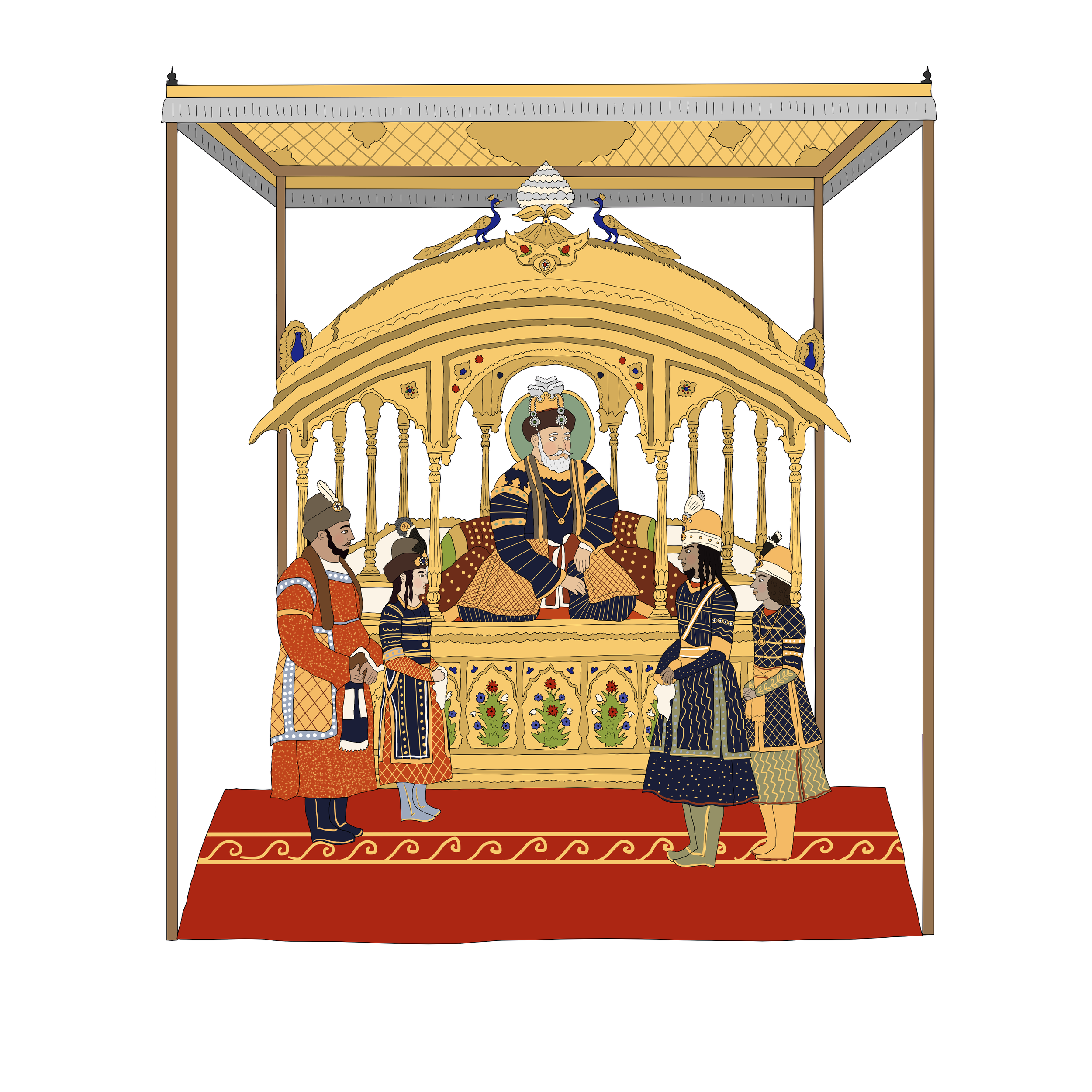
However, this parade is only the latest in a long line of grand public events held by the rulers of Delhi throughout history, with one example being the Delhi durbars of the British Raj. Although they may seem like the opposite of the Republic Day parades – celebrating colonial rule, rather than Indian sovereignty – they are both linked through their usage of pageantry and ceremonial ritual as an expression of ruling ideology.
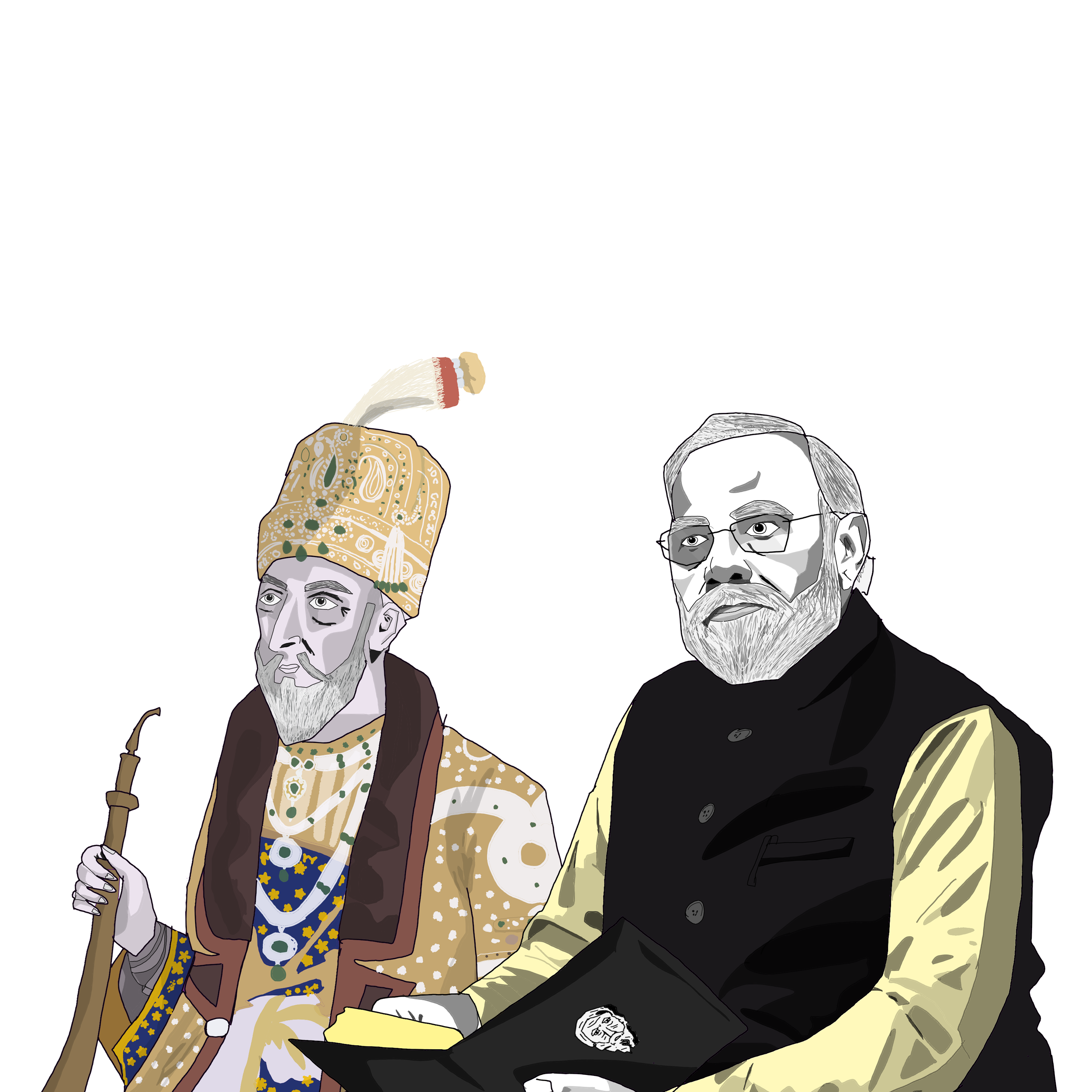
To understand why the Delhi durbars existed, we must wind the clock back to the 19th century. Although the British had already established a presence in India by the early 1800s, much of India’s legal situation was still ambiguous. Despite its capture by the East India Company in 1803, the capital of Delhi was still technically under the rule of the Mughal Emperor, who held the title of ‘Prince of Delhi’. In spite of his severely limited purview, it was from him that the company derived its legitimacy. However, this changed in 1857, when Indian soldiers revolted, and later proclaimed the last Mughal heir – the octogenarian Bahadur Shah Zafar – as the ‘Emperor of Hindustan’.
The revolt was quickly crushed, bringing an official end to both Mughal and Company rule, with both of their powers being transferred to the British crown. So, for the first time since the British arrival in the 17th century, the people of the subcontinent were to be treated not as subjects of the Mughal emperor, but as those of the British crown itself. Yet, if the revolt – which had seen mass violence against Christian missionaries and churches – had taught the British anything, it was that they had to adapt to Indian culture if they wished to maintain control over the subcontinent.
The word ‘durbar’ is originally Hindustani, with Persian origins. Initially, it was used to refer to the Mughal court. Here, the emperor would receive audiences from his subjects, who would have titles bestowed upon them in exchange for loyalty. The British had frowned upon this practice during the Mughal period, considering it to be little more than a form of bribery. However, only shortly after the end of the rebellion, the new Viceroy of India, Lord Canning, embarked on ‘durbars’ of his own. Canning went on a tour of north India characterised by multiple ‘durbars’, at which he met with and rewarded loyal noblemen. This began with a proclamation at Allahabad (now Prayagraj) in 1858, where he announced the transfer of Indian rulership from the Company to the British crown. Meanwhile, he assured protection for the Indian aristocracy and limited interference in religious affairs. This volte-face can be seen as characteristic of the change in British policy towards India as a whole – as the historian Thomas Metcalf puts it, Britain ceased to view India as a “land to be remade in Britain’s image”. Instead, they wished to preserve what they saw as the natural order of her feudal, even ‘medieval’ society, regardless of social upheaval chipping away at this supposedly natural order in Europe.
When the first ‘Delhi durbar’ occurred in 1877, it was under Robert Bulwer-Lytton, 1st Earl of Lytton. As a longtime friend of the then-Prime Minister Disraeli, a lifelong conservative, and a former member of the medieval-romanticist ‘Young England’ group, he viewed the durbar as, fundamentally, a way to legitimise the ‘feudal nobility’ of India. Therefore, he saw Queen Victoria – the ‘Empress of India’ – as their liege. The choice of Delhi – then only a small city still in recovery from the revolt of 1857 – as the location for this event rather than the Raj’s capital, Calcutta, was particularly symbolic. This was due to Calcutta having been the Mughal capital and thus having established continuity between them and the British sovereign, who would be proclaimed empress there. Despite this, Queen Victoria herself did not attend, owing to her advanced age and the distance between India and Britain.
The so-called Imperial Assemblage of 1877 was nothing short of spectacular. At every camp, there were “strangers from every land” gathered to hear the proclamation – from “Beluchis [sic]… with long black locks and flowing beards” to “Burmese in nondescript garments of silk and satin”. Elephants were on parade, with their howdahs like “thrones of gold and silver,” and the sigils of their royal owners emblazoned on them. They were accompanied by horsemen in “medieval chain armour” and a host of native rulers, primarily described by the contemporary writer as either “Rajput,” “Muhammadan,” or “Mahratta”. This proves to be one of many examples of the British obsession with racial classification. In total, 63 “ruling chiefs” were present, alongside envoys from Portuguese India, Kalat (Balochistan, Pakistan), Siam (Thailand), Muscat (Oman), Nepal, and Kashgar (Xinjiang, China).
The aesthetics of the event combined traditional Indian architecture with some influence from European feudalism. The event was inaugurated by six trumpeters in medieval European costume, with each prince being assigned a coat of arms while other loyal Indians were assigned knightly titles. Despite this cultural incompatibility, it is not difficult to imagine many onlookers being captivated by this spectacle. In this aspect, it can be seen as an expression of what the anthropologist Clifford Geertz called the ‘theatre-state’. This was where rulers relied not only on conventional methods of control, but on the exhibition of spectacle and regal ritual as means of exercising power.
Throughout each of the Delhi durbars, there was some variation, but the ideas expressed remained the same. At the durbar of 1903, there was a more conscious effort to incorporate Indian aesthetics. This fit with the pretences of the then-Governor General, Lord Curzon, who was a man with a seemingly endless fascination for the so-called “Orient”. Yet, this was not framed, or even viewed as, contradictory with the British rhetoric of racial supremacy. Rather, it was a reiteration of an idea that the British favoured: that the “effeminate” Indian’s natural place was submission to foreign, culturally (if not racially) superior conquerors. So, the British framed themselves as only the most recent among them.
The durbar of 1911 – the only one actually attended by a British monarch – occurred amidst an environment of popular unrest and discontent. This stemmed from both the Partition of Bengal, and the growth of a revolutionary nationalist movement led by groups such as the Anushilan Samiti and the Jugantar in the east. The attendance of thousands of Indians allowed the British to challenge the nationalist Congress. They disputed its claims that it represented the popular desires of Indians by pointing to the supposed loyalty of her Indian subjects. At the same time, two major announcements were made at the durbar – the revocation of the partition of Bengal, and the shifting of the Raj’s capital from unrest-hit Calcutta to Delhi. These both aimed at addressing the growing nationalist movement in Bengal.
Quickly, the Congress began to incorporate elements of the durbars into their meetings – with grandiose processions and passionate speeches. This was in much the same way as they had incorporated British imperial ideology into their own demands for Indians to be better treated under the empire. Yet, just as it became more clear following World War I that the British were not going to allow India self-rule, the rise of Mahatma Gandhi as a national leader imbued Indian nationalism. He did this with a new, rustic aesthetic sensibility, drawn not from the British and their lavish, aristocratic rituals but from an idealised image of the Indian peasantry. As Britain began to come to terms with India’s growing national consciousness, rituals of power like the Delhi durbar became increasingly obsolete; with the 1911 durbar being the last of such events. However, these rituals of power did not completely fade into the past.
Upon looking back at the first few Republic Day Parades, it is hard not to see some imprints of the old Delhi durbars, refitted to suit the new national identity of the Indian republic. The correspondences of Prime Minister Nehru showed a careful, conscientious effort to display the new Republic of India’s cultural diversity, enlisting folk dancers from across the country to represent their individual states via tableaux. While the old Delhi durbars had focused on royal ritual to represent India’s many princes, the new one was distinctly democratic in its framing. It had a focus on folk culture, albeit filtered through the lens of the Indian state. In 1964, for example, shortly after a disastrous war with China, the Republic Day floats for NEFA (Arunachal Pradesh) and Jammu and Kashmir (now, a separate union territory) were marked by reminders of a perceived return to normalcy. On the former, the message “Towang [sic] back to normal” was inscribed, while the latter depicted Indian soldiers coexisting peacefully with locals. Of equal, if not more, importance, this newly constructed ritual has been displaying the military strength of the Indian state, and its constant vigilance against the military threats. These have been shown towards threats posed by China and Pakistan – whether in 1963, 1966, 1971, or 2026.
While the early manifestations of Republic Day parades served to convey the developmentalist aspirations of Nehruvian ideology, its modern incarnations are microcosmic of India’s political shifts. Towards the 1990s and the 2000s, as India shifted towards neoliberalism, the tableaux increasingly began to represent economic growth. Following the election of Modi and the Hindu-nationalist BJP in 2014, they have also begun to display a distinct vision in line with the Hindu-nationalist ideas of Prime Minister Modi’s BJP. The 2024 tableau for Uttar Pradesh, governed by the BJP, displayed the Hindu deity Ram standing triumphantly next to a temple. This represented a then-recently consecrated temple, whose construction had long been a demand of the Hindu right. Similarly, many other BJP-ruled states’ tableaux also displayed redeveloped temples, in line with the government’s official rhetoric of recovery from 500 years of “foreign” (Muslim and British) rule.
Much like the Delhi durbars, therefore, India’s Republic Day parades are not politically neutral spectacles. Instead, they are selective deployments of imagery in line with the ideological priorities of India’s ruling governments. Such rituals, embodying the concept of the theatre-state as defined by Geertz, are likely to become even more important in the future. As we enter a world defined by bombastic and hyperreal politics, defined as much by extreme rhetoric as by pomp and larger-than-life manifestations of power, the link between imagery and government remains extremely significant.
Bibliography
Dalrymple, William., The Last Mughal: The Fall of a Dynasty, Delhi 1857 (London, 2006)
Cohn, Bernard S., “Representing Authority in Victorian India”, in Eric Hobsbawm and Terence Ranger (eds.), The Invention of Tradition, pp. 165-209 (Cambridge, 1983)
Mackenzie, John M., “Exhibiting the empire at the Delhi durbar of 1911: Imperial and cultural contexts”, in John McAleer and John M. MacKenzie (eds.) Exhibiting the empire: cultures of display and the British empire, pp. 194-219 (Manchester, 2015)
Metcalf, Thomas R., Ideologies of the Raj (Cambridge, 1995)
Wheeler, J. Talboys, The History of the Imperial Assemblage at Delhi held on the 1st January 1877 (London, 1877)
Roy, Srirupa, “Marching in Time: Republic Day Parades and the Ritual Practices of the Nation-State.” in Srirupa Roy, Beyond Belief: India and the Politics of Postcolonial Nationalism, pp. 66-104 (Durham, NC and London, 2007)
Zubeiri, Fahad, “How the Republic Day parade became a site for Hindu nationalist myth-making” Frontline (23 Jan 2026), https://frontline.thehindu.com/the-nation/republic-day-parade-indian-hindu-identity-politics/article70540910.ece