
After a Fat Pope, A Thin Pope: What can history tell us about the direction of Leo XIV’s Papacy? (MT25)
I will never forget the feeling of leaning over a friend’s phone at the pub, watching as Robert Prevost of Chicago stepped out onto the balcony of St Peters in early May this year. As an amateur Vaticanista I thought that I had really done my homework on the papabile, but I was mistaken. Annoyingly, Prevost had been on my radar ever since his meteoric elevation to the Dicastery for Bishops in 2023 – but like so many others, I had thought it inconceivable that an American should be elected Pope. How wrong I was!
Aside from a lesson in humility, the election of a ‘black horse’ candidate led me to consider the direction of a Pope who, until his election as Leo XIV, had been reserved in his public statements. More importantly, would this new Papacy would be radically distinct from Leo’s predecessor of blessed memory, Pope Francis? To answer these questions, and discern the likely trajectory of Leo XIV’s embryonic papacy, we can look to history for examples of other pontifical transitions; other papal ‘new beginnings’. Specifically, a broad snapshot of the 16th century papacy – a century where the temporal powers of Pontiffs reached their zenith, and where the changes between each Petrine successor seemed most volatile – has much to tell us when contrasted with today.
Like any ecclesiastical historian trying to gain popular attention, I will start with the sex-ridden sleaze of Alexander VI (r.1492-1503). Even before his election, the father of several children, Cardinal Rodrigo Borgia, was a rival of Cardinal Giuliano della Rovere. Both were leaders of their clans, both were cardinal-nephews, neither of them was ‘Roman’; these superficially similar clerics seethed with mutual resentment. Upon his simony-ridden election (according to Burchard), the newly crowned Alexander VI engaged in a violent clash with his old rival. Giuliano fled to Ostia, and by 1494 was on a ship bound to the French court in Lyons, where he would collude against the pope with King Charles VIII. When Alexander died in 1503, his son Cesare was unable to secure a friendly successor, and after the brief interlude of Pius III (22 Sept-18 Oct 1503), Giuliano was unanimously elected as Julius II. The new pope, taking his name from Caesar himself, set in motion an anti-Borgia iconoclasm, physically destroying the family’s monuments and politically dynamiting their bases of support. When Julius II ‘the Warrior Pope’ died in 1513, he had figuratively salted the earth of the Borgia domains and tarnished the legacy of his predecessor.
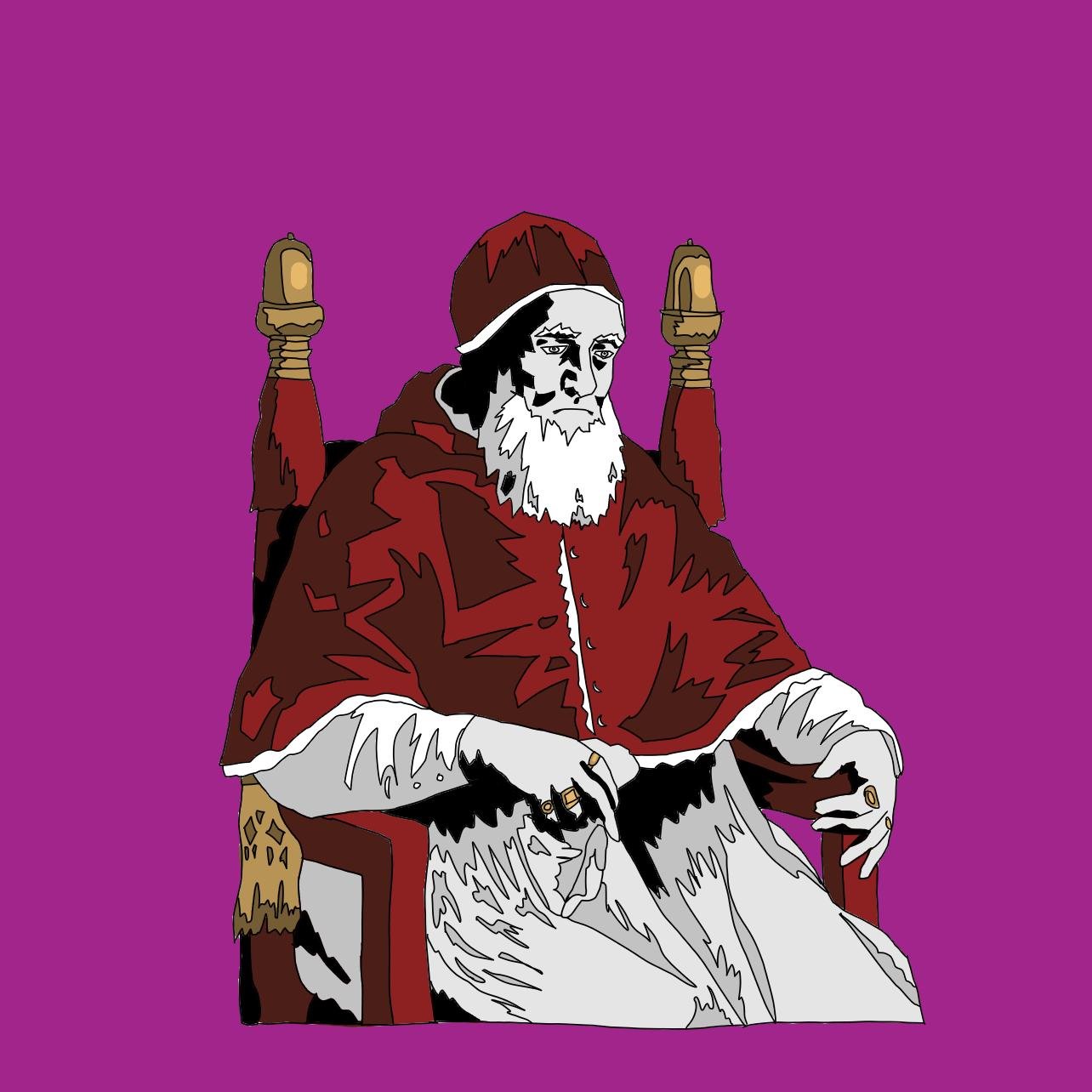
Yet the idea that these two pontiffs were totally distinct in their politics is not entirely true. Just as Alexander and Julius answered to similar descriptions as cardinals, so they did likewise as popes. They put their own dynasties above all else – Alexander secured the Duchies of Gandía, the Romagna, and Squillace for his sons; Julius II secured the Duchy of Urbino for his nephew. Borja and della Rovere also advanced numerous nephews to the ‘red hat’; with eight Borja Cardinals were created by Alexander VI, and five family members of Julius II’s shared the honour during his reign. Nepotism was a thread that tied these two former enemies together. True – foreign policy did change overnight after the Conclave of October 1503, as the pro-French Julius II went from patronage to pursuit of Cesare Borgia, but the effect of Julius’ pontificate was much the same as Alexander’s. Unsurprisingly, the della Rovere Duke parachuted into Urbino was replaced, much like Cesare Borgia, by the Medici family. The individual beneficiaries in the papal court changed, but the overall picture of simoniac nepotists vying for power didn’t.
This example should be followed by that of Paul IV and Pius IV; two popes with entirely different political and spiritual behaviours, despite sharing some interesting qualities in common. Paul IV (r.1555-59), born Gian Pietro Carafa, was a dichotomous pope, a puritanical pontiff. He was the son of the very noblest of aristocratic Neapolitan families, and the nephew of Cardinal-Dean Oliviero Carafa. Yet, as a bishop, he founded the ascetic Theatine Order, going on to prohibit books deemed to be sacrilegious and forcing Roman Jews into a ghetto when Pope. Paul IV was not, however, above a little bit of 16th Century nepotism, elevating his ‘nipoti’ to the cardinalate. His feckless nephew, Carlo Carafa, who was a rumoured murderer, was just as unpopular as his uncle. This unpopularity made Carlo’s position precarious during the sede vacante after his uncle’s death. In a moment of unadulterated ambition, he voted in favour of the Spanish, who in the words of Hollingsworth was ‘lulled into a false sense of security... by the emollient promises of (ambassador) Vargas’. The candidate elected Cardinal de Medici, now Pius IV), ordered for Carafa and his brother the Duke of Paliano, to be arrested and executed in the Castel Sant’Angelo in 1561. However justified Pius was in his indictment of Carafa, this blatant coup was one of the most explicitly bloodthirsty in Papal history – a prince and a cardinal executed by the next pope!
However, here too Pius IV’s pontificate was not one of complete contradiction to his predecessor, Paul IV. After elevating three of his nephews to the red, one nephew, Carlo Borromeo, continued the asceticism of Paul IV’s reign. He believed that a good Tridentine Cardinal should live not for ‘riches or luxury but to labour and care for the Glory of God’. In doing so, despite holding the lavish see of Milan, Carlo became a model for future counterreformation cardinals by giving up his renaissance palace and serving the poor; a major factor behind his speedy 1610 canonization. Similarly, Cardinal Ghisleri, elected in 1565 as Pius V, went along with his predecessors in their new-found humility; keeping a monastic diet and reducing his nepotism to but one cardinal-nephew. Therefore, despite Pius IV’s pontificate being perhaps violently distinct from the Carafa pontificate, his reign did not renege on the Tridentine ideas of humble piety for the senior clergy, and the example of his Cardinal-nephew San Carlo Borromeo, made for a discrete continuation of Paul IV’s earlier Theatine principles.
The popes of the 16th Century demonstrate a consistent pattern; a moral and political pendulum that swung rapidly, sometimes overnight, between papal interregna. These disputes were nearly always bloody and shifted the entire foreign and domestic policy of the Papal States, and Church as a whole, spontaneously. Yet, beneath this, pontiffs did maintain a continuity of behaviour; despite being viscerally politically opposed; the trends of nepotism and in a more positive way, Tridentinism, were constant across sede vacantes.
So then, we have discovered that the direction of the ecclesial and secular governance of the Church can change in an instant, when the Pope-elect says ‘accepto’ to the Cardinal-dean. Will the Leonine Papacy of the second quarter of the 21st Century be different to Francis’? This question, of course, can only be answered by speculation, and time will tell how distinct or similar their papacies shall be – but there are clues.
Which cardinals will be appoint? Fisher of Sydney? Delfino of Milan? Gomez of Los Angeles? Ulrich of Paris? These sees traditionally got cardinals, until Francis’ time, and therefore whether or not they see red hats will be an interesting insight. Perhaps the first sign of a change may be in liturgy. When Leo emerged onto the balcony, eyes were drawn to his scarlet papal mozzetta and cossa, which were totally absent from the beginning to the end of the Francis papacy. The recent indulgence of Cardinal Burke’s Traditional Latin Mass in St Peter’s on 25th October is likewise a sign of possible Vatican indulgence to the traditionalist wing of the Church, which it would not be unfair to say chafed under Francis.
However, if one expects a ‘180° turn’, one might be disappointed. There will definitely not be any events as dramatic as those stated in the above historical examples, nor a repeat of other papal melodramas such as the 897 Cadaver Synod. Remember that 80% of the total number of electors in the recent conclave were created during Francis’ pontificate; a meagre five of the electors were created by John Paul II, with the remainder being Benedict XVI appointees. The seditious concept Leo XIV is a secret anti-Franciscan, aside from being near-blasphemous, is totally improbable, and can only serve to cause of division in the Church.
Regarding synodality, Leo seems to be in favour. On Francis’ pontificate, Leo commented that “The legacy he has left us, in my view, is above all this: that synodality is a style...that helps us to be Church by promoting authentic experiences of participation and communion.” Such a central asset to the Church, surely must be a focus then for a cardinal who was deeply involved with the synodal process before his election. But more than in liturgy or in teaching, the greatest indicator of what is to come will found in tone. ‘Papa grasso, papa magro’, the thesis of this article, should perhaps be ‘after a loud pope, a quiet pope’. Perhaps politics and theology are secondary to the need for a calming period in the church. It may be that in the wake of Francis’ papacy, for all its brilliance, a calmer and less divisive voice should prevail for a while within the Vatican. It has been said that Leo is a quiet pope - someone who will cool the tension within and remind us of the Universality of the Church. Ultimately it is unlikely that the new papacy of Pope Leo XIV will be as stark in its differences to Francis’, as was the case centuries ago. Pope Leo is certainly his own man and has already made strides to bridge the growing gap between the braying factions within Catholicism. So, whatever his predecessors centuries ago did, Leo should symbolize for all Catholics continuity with the whole church, and with his predecessor Francis.