
Revolutionary - Michaelmas Term 2026
History rarely stands still. Some change comes so gradually it is barely felt until decades of hindsight bring it into focus; other change arrives all at once, upending in an instant what centuries had built. It is with this second, more dramatic kind of change in mind that The Herodotian announces its theme for the new academic year: Revolutionary.
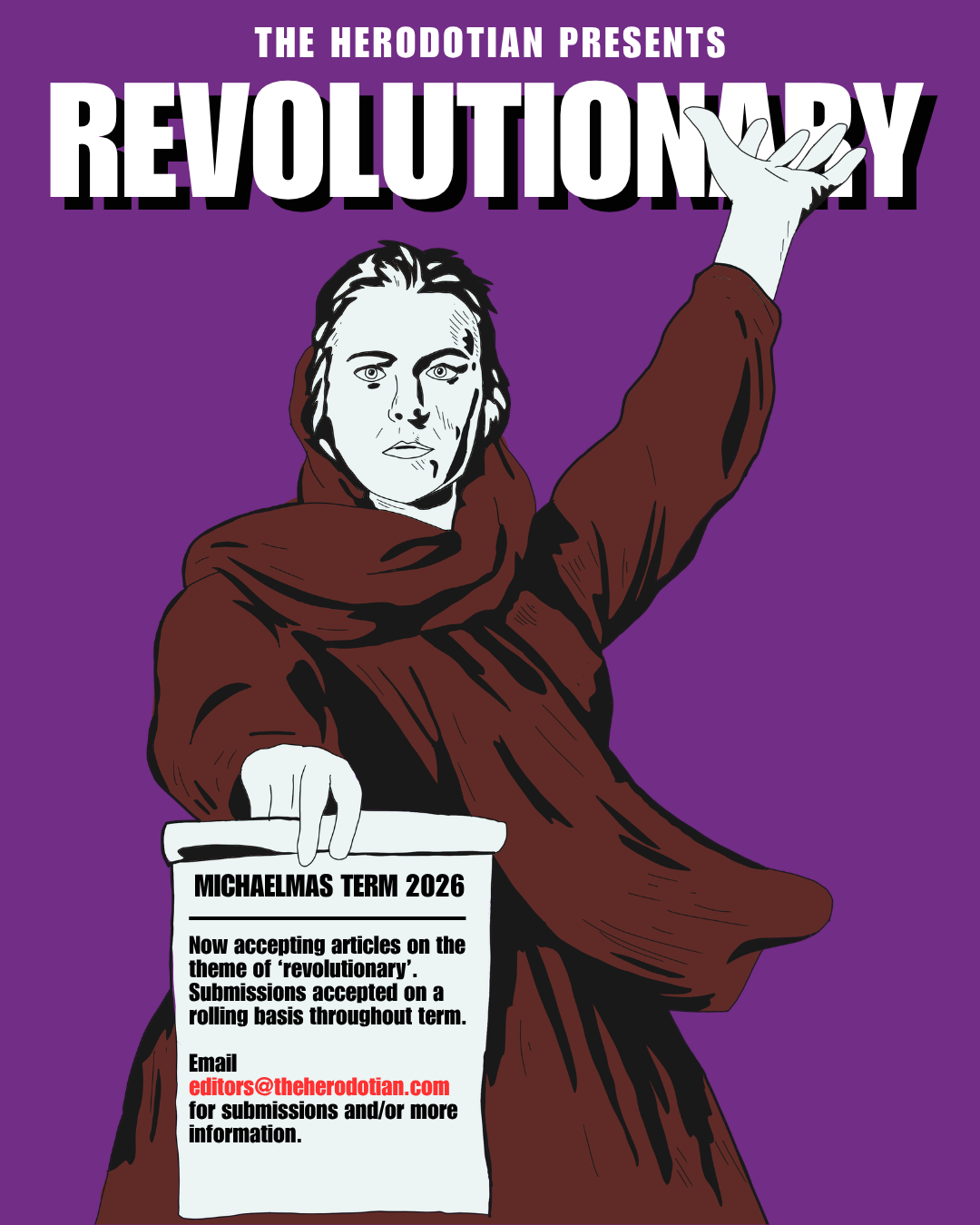
The word carries obvious political weight. Few centuries have passed without some ruler, regime, or entire order of society being overturned by those beneath it, from the expulsion of Rome's last king in 509 BC - an event so formative that the Republic dated its own liberty from it - to the storming of the Bastille, to the wave of civil rights movements that reshaped the twentieth century. But revolutions are not the exclusive property of statesmen and crowds. Science has had its own: Copernicus's insistence that the earth moved around the sun and not vice versa unravelled a thousand years of settled cosmology, and Darwin's Origin of Species did much the same to certainties about humanity's own place within it. Even the humble printing press proved revolutionary, turning the written word from the preserve of the few into the property of the many, and in doing so changing how ideas of every kind — political, scientific, and otherwise — could spread at all.
That is only a fraction of what "Revolutionary" might mean to you. You might trace a revolution in thought as readily as one in the streets; a shift in how an era understood art, faith, or itself. You might look as closely at revolutions that failed as those that succeeded, or ask what made certain ideas dangerous enough to be worth overturning a throne for. As ever, the editors impose only two conditions: your article must be historical, and it must be plausibly connected to the theme of Revolutionary. Within that, the choice is entirely yours.
There is something fitting about opening a new academic year with this theme. Oxford has produced more than its share of revolutionary people who changed how others thought, ruled and saw the world. This term its student community, be they incoming freshers or familiar faces, join that same long, occasionally disruptive tradition. We can think of no better way to welcome you than with an invitation to think, write, and argue as boldly as the people you'll be writing about.
"De l'audace, encore de l'audace, toujours de l'audace."
("Audacity, more audacity, always audacity.")
— Georges Danton, 1792.
